Learn the types of money-only cases that may be brought in NYC Small Claims Court, including property damage, unpaid money, deposits, contracts, and consumer disputes.
Introduction
NYC Small Claims Court is for money-only disputes. That means the court can hear many everyday conflicts where one side says the other owes money, as long as the claim fits the court’s rules and dollar limit. Official New York court materials explain that small claims cases often involve unpaid money, damage to property, deposits, contracts, leases, and consumer-type problems.
Disclaimer: This article is for informational purposes only. We are not attorneys and do not provide legal advice.
Quick Answer
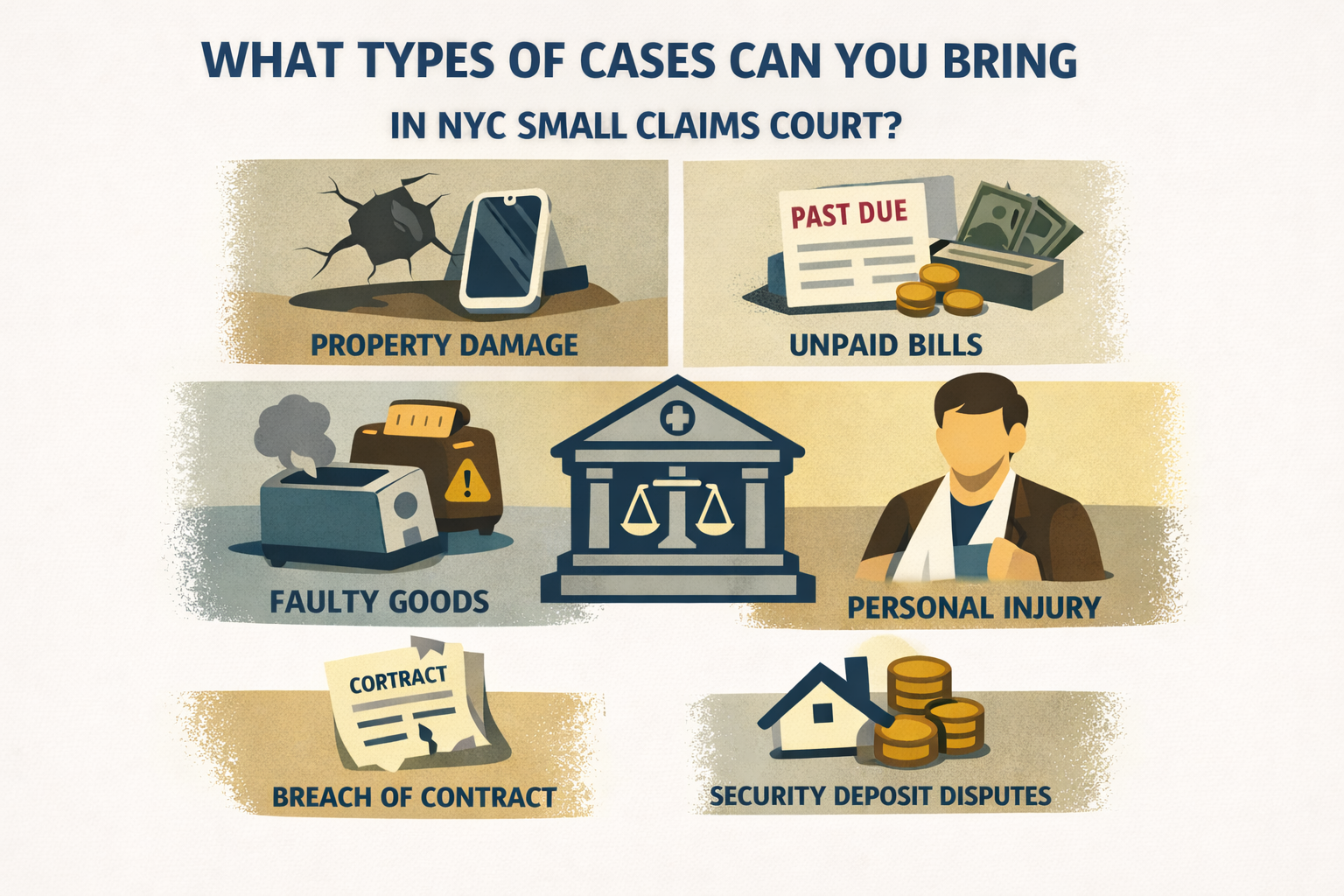
In NYC Small Claims Court, common case types include:
- money owed,
- property damage,
- security deposit disputes,
- contractor or service disputes,
- defective product claims,
- breach of agreement claims,
- refund disputes,
- and other cases where one side is asking for money only.
The NYC Bar small claims guide lists typical claims such as breach of contract, property damage, warranty issues, lease disputes, and unpaid money.
The Main Rule: Money Only
The most important rule is that NYC Small Claims Court is for cases where you are asking for a money judgment. The court is not meant for orders forcing someone to do work, return property, cancel a contract, or stop certain behavior. Official court guidance says small claims is for suing for money only.
Common Types of Cases You Can Bring
Money Owed
These are some of the most common small claims cases. Examples include:
- unpaid personal loans,
- unpaid shared bills,
- unpaid rent share,
- or money that should have been repaid but was not.
Property Damage
Small claims court commonly handles money disputes involving damage to:
- cars,
- apartments,
- personal belongings,
- or other property.
The NYC Bar guide specifically lists damage to personal or real property and damage to an automobile as standard small claims examples.
Security Deposit and Lease Disputes
Landlord-tenant money disputes often appear in small claims court, especially when the issue is:
- a security deposit,
- unpaid rent balance,
- or money tied to a lease dispute.
The NYC Bar guide specifically includes lease-related disputes among the types of claims often brought in small claims court.
Contractor, Mechanic, and Service Disputes
You may also see cases involving:
- unfinished work,
- poor workmanship,
- services not performed,
- overbilling,
- or damage caused during a service.
These usually fit if the person filing is asking for money to cover the loss.
Consumer and Retail Disputes
Small claims court is often used for consumer problems such as:
- defective products,
- denied refunds,
- overcharges,
- or goods or services that were not delivered as promised.
The NYC Bar guide specifically mentions breach of warranty and similar consumer disputes.
Breach of Contract or Agreement
Many small claims cases are based on an agreement that one side says was not followed. That can include:
- written agreements,
- verbal agreements,
- service contracts,
- or promises tied to payment.
The NYC Bar guide directly lists breach of a contract, lease, warranty, or agreement as a typical small claims category.
Warranty and Guarantee Disputes
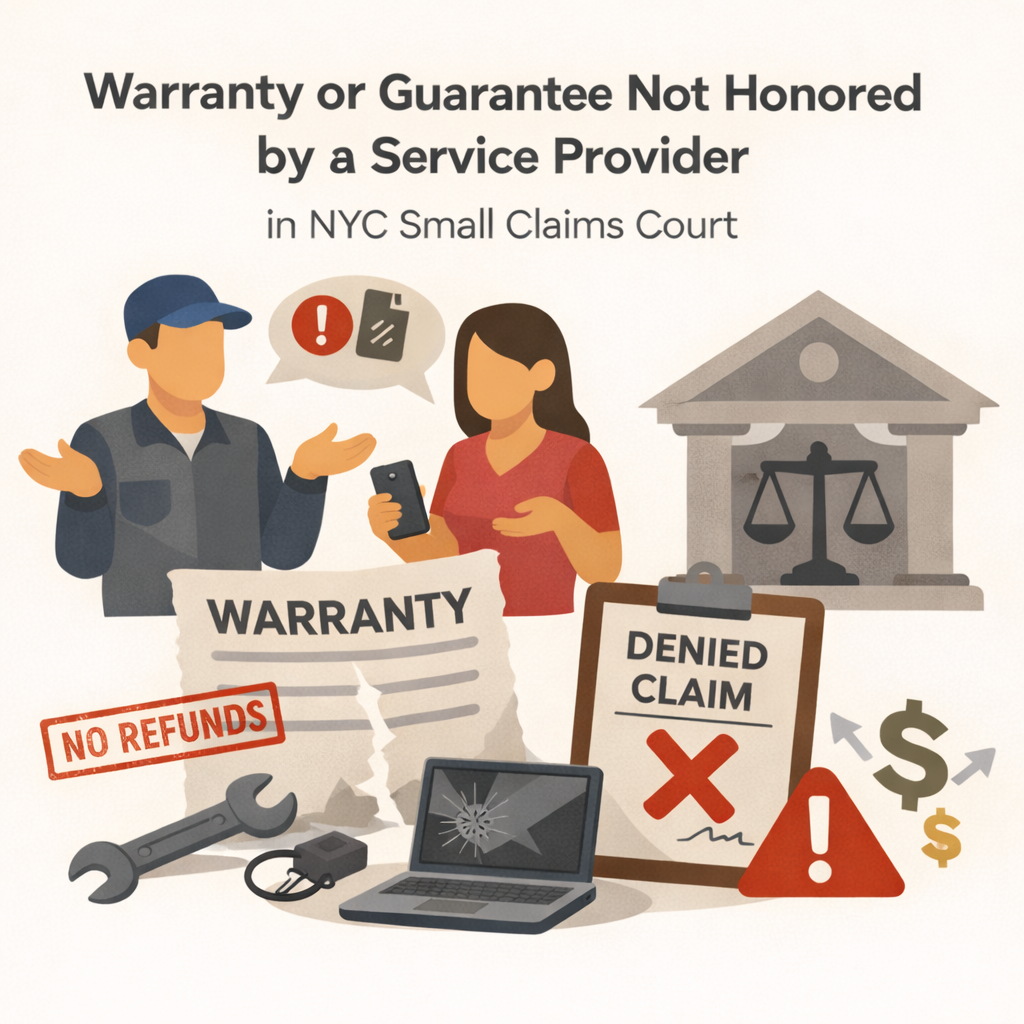
If an item or service came with a warranty or guarantee and the business or provider did not honor it, that type of money dispute may also fit in small claims court. Warranty disputes are specifically identified in public small claims guidance.
Bounced or Stopped Check Claims
The NYC Bar guide also lists disputes involving bounced or stopped checks as a standard example of the kinds of money claims often brought in small claims court.
Lost Property, Luggage, or Loss of Use of Property
Other examples listed in public small claims guidance include:
- loss of luggage,
- loss of personal property,
- and loss of use of property.
These are less common than some other categories, but they are still recognized examples of small claims matters.
What Types of Cases Usually Do Not Fit?
A case usually does not fit NYC Small Claims Court if the person is asking the court to:
- order someone to do something,
- force someone to stop doing something,
- return property instead of paying money,
- or handle a claim above the court’s dollar limit.
The official small claims page makes clear that the court is for money judgments only.
Quick Reference
- NYC Small Claims Court is for money-only disputes.
- Common case types include money owed, property damage, deposit disputes, service disputes, and consumer claims.
- Public guidance also lists breach of contract, warranty disputes, bounced checks, lease disputes, and lost property.
- Cases asking for something other than money usually do not belong in small claims court.
Conclusion
NYC Small Claims Court covers many of the most common everyday money disputes, from unpaid debts and deposits to property damage and consumer problems. If the dispute is really about money owed and fits the court’s rules, it may be the kind of case that belongs in small claims court.
If you need help getting started, we offer preparation and filing services to make the process easier and more organized.