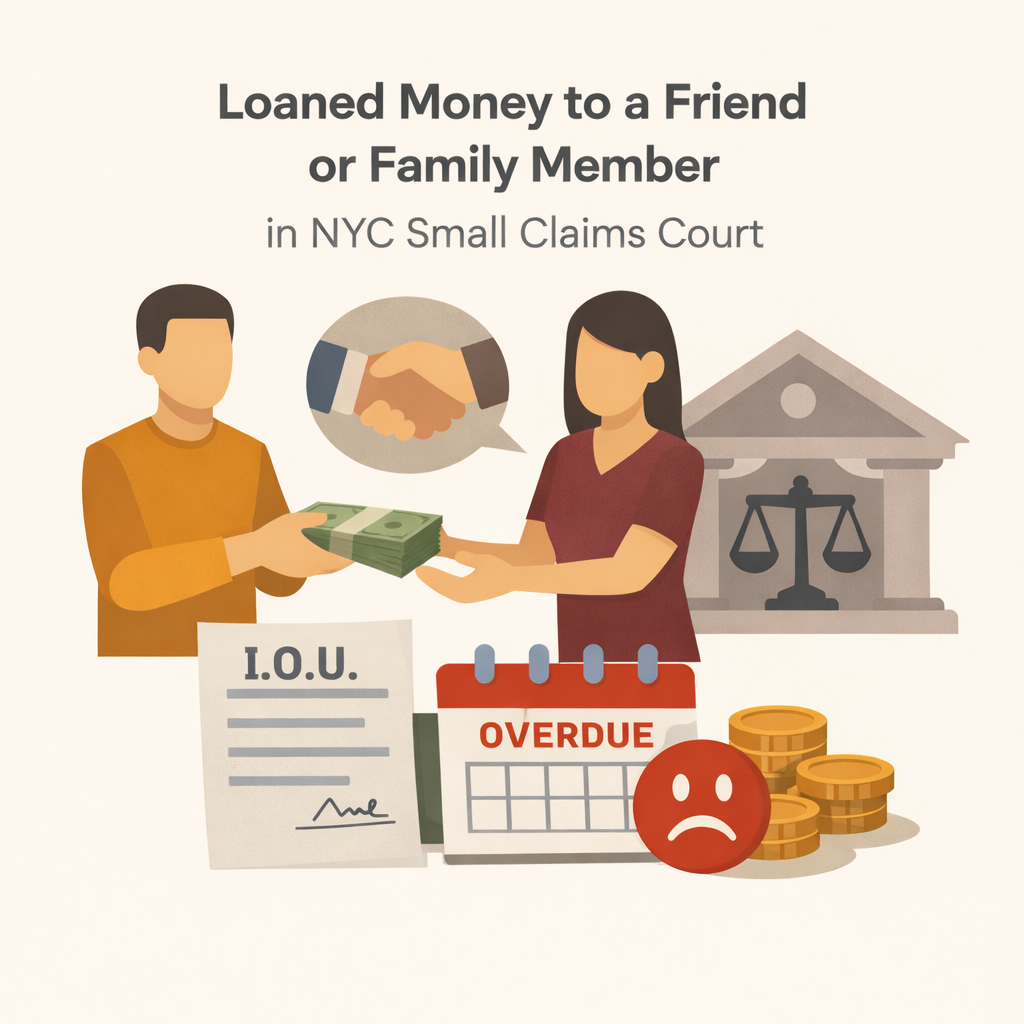
Learn how loaned money disputes with friends or family may be handled in NYC Small Claims Court, what proof helps, and when the claim may fit under the $10,000 limit.
Introduction
Loaning money to a friend or family member can become a serious problem when the money is not paid back. In NYC Small Claims Court, these disputes may often be brought when the person filing is asking for money only and the total amount claimed is $10,000 or less. The official NYC courts say Small Claims Court has jurisdiction up to $10,000 and is for money claims, not for forcing someone to do something else.
Disclaimer: This article is for informational purposes only. We are not attorneys and do not provide legal advice.
Quick Answer
Yes, if you loaned money to a friend or family member and they did not repay it, the dispute may fit in NYC Small Claims Court if you are seeking money and the claim is within the court’s limit. Small Claims Court in NYC is designed for money disputes, and public court-help materials specifically describe it as a place to sue for money without a lawyer.
Is Loaned Money a Small Claims Case?
In practical terms, this is usually treated as a money owed dispute. Even if the loan was informal, the court generally looks at whether money was given, whether it was supposed to be repaid, and whether repayment did not happen. The NYC Bar’s small claims guide lists breach of agreement-type disputes among common small claims categories, and unpaid personal loan disputes often fit into that general type of claim.
Do You Need a Written Loan Agreement?
No, not always. A written agreement can help, but many real-life disputes between friends or relatives involve less formal proof. Helpful records may include:
- text messages,
- emails,
- Venmo, Zelle, Cash App, or bank transfers,
- notes or IOUs,
- repayment promises,
- and messages asking for more time or acknowledging the debt.
New York court-help materials emphasize bringing the records and documents needed to prove your case.
What Do You Usually Need to Show?
For this type of case, the main points are usually:
- money was given,
- it was a loan and not a gift,
- repayment was expected,
- and the money was not repaid.
That distinction between a loan and a gift is often the most important issue in these cases. If the other side says the money was a gift, records showing repayment discussions or promises can become very important. This is why organized proof matters so much in small claims court.
What Kind of Proof Helps Most?
The strongest proof is usually anything that clearly shows the money was expected to be paid back. Examples include:
- an IOU,
- a written repayment plan,
- messages like “I’ll pay you back next week,”
- bank or payment app records,
- receipts,
- or witness testimony from someone who knew it was a loan.
The official court-help materials say Small Claims Court is for money disputes and that parties should come prepared with records and proof.
What If There Was No Deadline to Repay?
That can make the case less clear, but it does not always prevent a claim. The issue often becomes whether the money was still expected to be repaid at all. If there was no exact repayment date, messages requesting repayment and responses acknowledging the debt may help explain the situation. Because Small Claims Court focuses on practical money disputes, the court will often look closely at the evidence showing what both sides understood. This is an inference based on the court’s emphasis on proof and money-only disputes.
Can You Sue a Family Member in NYC Small Claims Court?
Yes. The court rules do not prevent a claim just because the defendant is a relative or friend. The main question is whether the case is a qualifying money dispute and whether the defendant has the right connection to the court. NYC small claims is for money claims up to $10,000, and individuals 18 or older may sue there.
Can You Sue for More Than $10,000?
No, not in NYC Small Claims Court. The official NYC small claims page says the court’s limit is $10,000, and claims above that amount must be started in the Civil Part or another court. The courts also say you cannot split one larger claim into multiple small claims to get around the limit.
Quick Reference
- NYC Small Claims Court is for money-only disputes.
- The NYC small claims limit is $10,000.
- Loaned money disputes often turn on whether the money was a loan or a gift. This is a practical inference from how these cases are usually proved.
- Helpful proof may include IOUs, messages, bank records, and repayment discussions.
- Adults can sue in NYC Small Claims Court, and friends or relatives are not excluded as defendants.
Conclusion
If you loaned money to a friend or family member and they did not repay it, NYC Small Claims Court may be an option when the dispute is really about money owed and the amount is within the court’s limit. In these cases, the clearer your proof is that the money was a loan and not a gift, the stronger your presentation will usually be.
If you need help getting started, we offer preparation and filing services to make the process easier and more organized.