Learn how bounced check or stopped check claims work in NYC Small Claims Court, what proof to bring, and when these money disputes may fit under the $10,000 limit.
Introduction
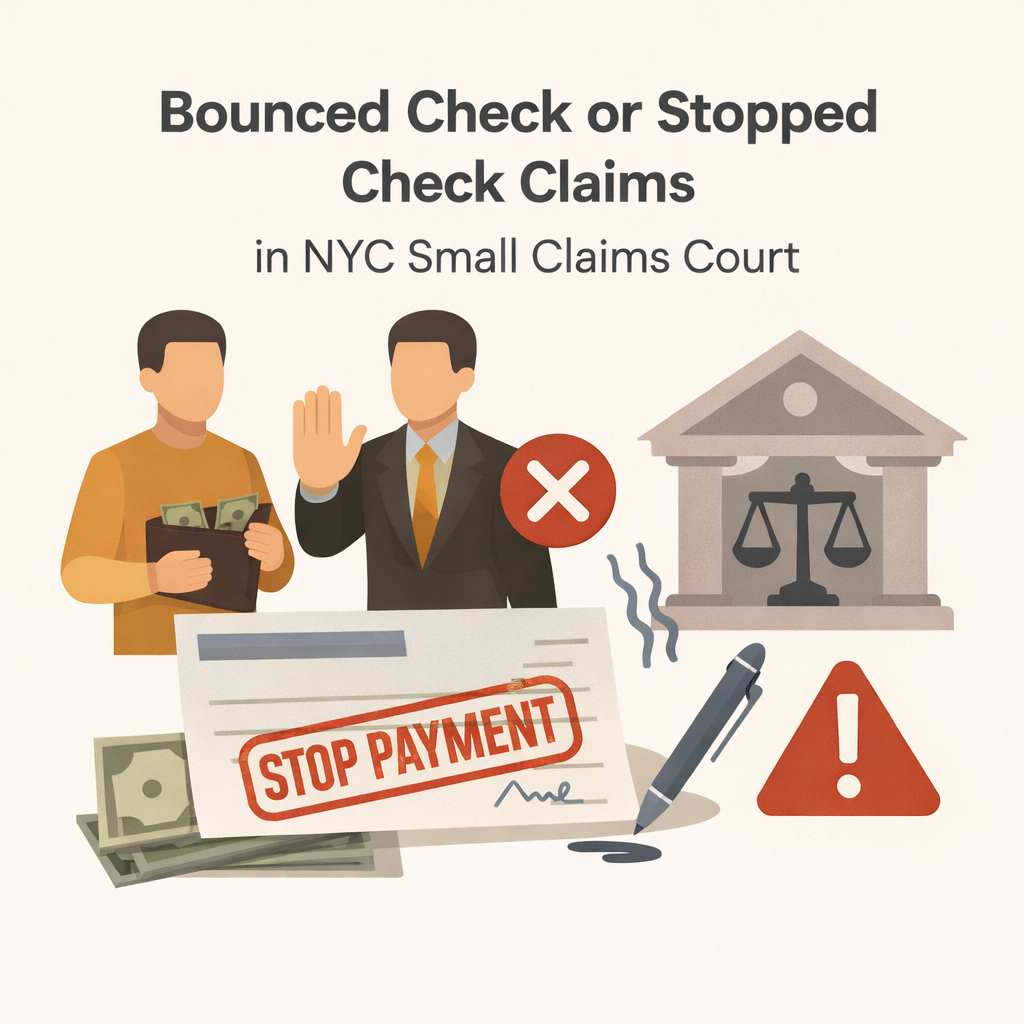
A bounced check or stopped check claim usually comes up when someone gave a check for payment, but the money was never actually received. In NYC Small Claims Court, this type of dispute can often be brought if the claim is for money only and the amount sought is within the court’s $10,000 limit. Official small claims materials specifically list “bounced or stopped check” as a common small claims case type.
Disclaimer: This article is for informational purposes only. We are not attorneys and do not provide legal advice.
Quick Answer
Yes, a bounced check or stopped check dispute may fit in NYC Small Claims Court if you are asking for money that you say should have been paid but was not. These cases are usually treated as money-owed disputes, and NYC Small Claims Court is designed for money-only claims up to $10,000.
What Is a Bounced Check?
A bounced check usually means a check was deposited or presented for payment, but the bank did not honor it. A stopped check usually means the person who wrote the check asked the bank not to pay it. In either situation, the basic problem is the same: the person expecting payment says the money was never received. Small claims guides treat both as standard examples of cases that may be brought in small claims court.
When Might This Become a Small Claims Case?
These cases often arise when someone was paid by check for:
- goods sold,
- services rendered,
- rent,
- a personal loan,
- or another money obligation,
and the check was later dishonored or payment was stopped. Public small claims guidance lists both unpaid money disputes and bounced or stopped checks among common case types.
What Do You Usually Need to Show?
For this kind of claim, the most important points are usually:
- a check was given,
- the check was not honored or payment was stopped,
- and the money is still owed.
Helpful proof may include:
- a copy or image of the check,
- bank notices,
- deposit records,
- invoices or receipts,
- written agreements,
- texts or emails about the payment,
- and any communication showing the check was refused or canceled.
Court-help materials consistently emphasize bringing organized records and documents to prove a small claims case.
Can You Sue for More Than the Check Amount?
In many real-world disputes, people also want to recover related losses such as fees or costs connected to the failed payment. The central small claims issue is still whether the person is seeking money only and whether the total claim fits within the court’s $10,000 limit. NYC Small Claims Court does not handle claims asking the court to force someone to do something; it handles money disputes.
Does the Other Side Have to Be a Person?
No. A bounced or stopped check case may be against an individual or a business, depending on who gave the check and who allegedly owes the money. NYC small claims rules allow businesses to be sued in small claims court, even though formal business entities generally cannot start a regular small claims case in that same way.
Do You Need the Original Check?
It is helpful to have the strongest proof available. In many cases, bank records, deposited-check images, account notices, and related written records may help show what happened. New York court materials on small claims stress the importance of bringing the documents needed to prove your claim, and collection-related guidance also points to canceled checks and bank information as important records.
What Small Claims Court Can and Cannot Do
Small Claims Court may decide whether money is owed because of the bounced or stopped check. It generally cannot order broader non-money relief. In other words, the court is there to decide the money dispute, not to supervise the banking relationship or force some other non-money action.
Quick Reference
- Bounced or stopped check cases are recognized small claims case types.
- NYC Small Claims Court is for money-only disputes.
- The NYC small claims limit is $10,000.
- Helpful proof may include the check, bank notices, receipts, invoices, and messages.
- You may sue a person or business, depending on who allegedly owes the money.
Conclusion
A bounced check or stopped check claim can be a strong fit for NYC Small Claims Court when the dispute is really about money that should have been paid but was not. The clearer your records are about the check, the unpaid amount, and the underlying transaction, the easier it is to explain the dispute in court.
If you need help getting started, we offer preparation and filing services to make the process easier and more organized.