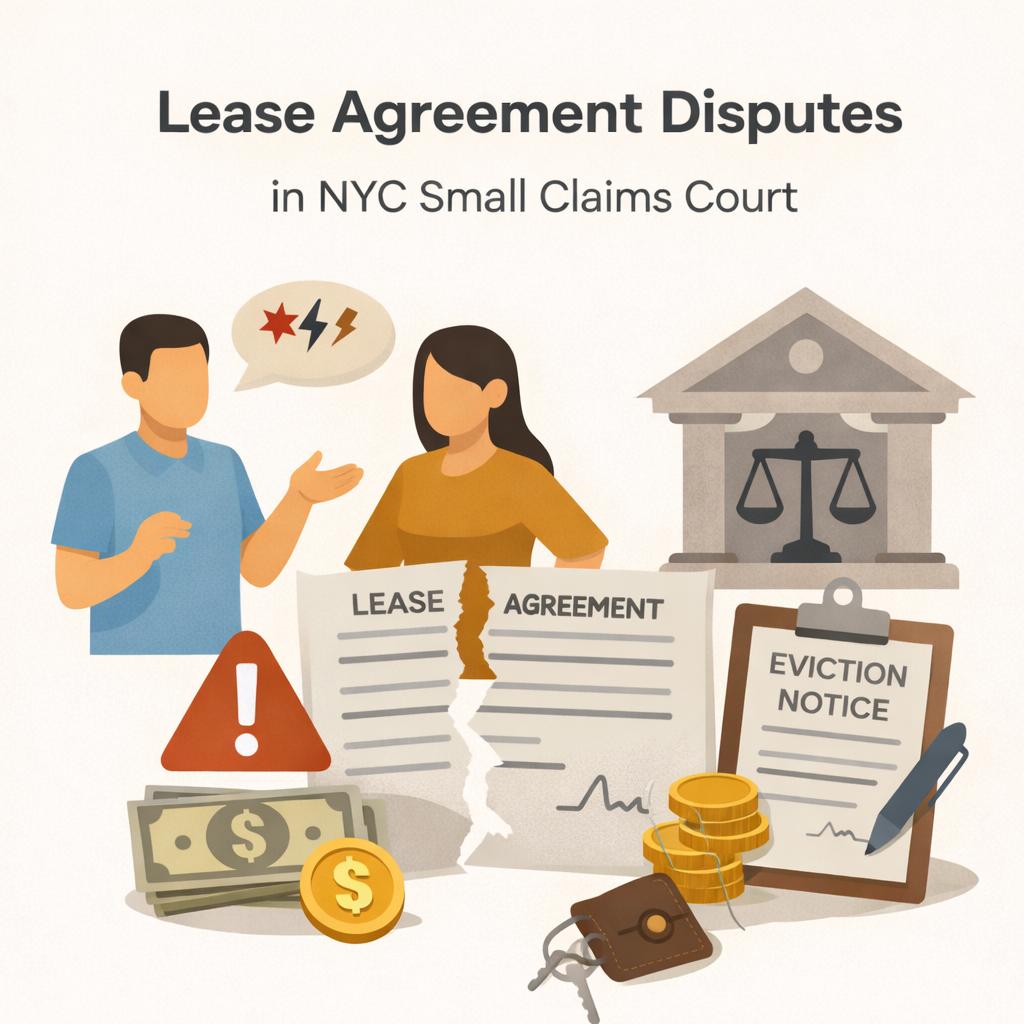
Learn when a lease agreement dispute may fit in NYC Small Claims Court, what money claims are allowed, and what proof may help your case.
Introduction
A lease agreement dispute may fit in NYC Small Claims Court when the issue is really about money and the amount claimed is $10,000 or less. NYC Small Claims Court handles monetary disputes only, while broader landlord-tenant matters are handled in other parts of the court system, including Housing Court.
Disclaimer: This article is for informational purposes only. We are not attorneys and do not provide legal advice.
Quick Answer
Yes, some lease agreement disputes can be brought in NYC Small Claims Court if you are asking for money only. Examples may include claims involving a security deposit, rent overpayment, money paid under a broken lease-related agreement, or other lease-based financial losses. If the case is really about eviction, possession of the apartment, or housing conditions, that usually points to a different court part rather than small claims.
What Counts as a Lease Agreement Dispute?
A lease agreement dispute usually means one side says the other side did not follow a rental agreement and that the failure caused a financial loss. Public small claims guides list disputes involving a lease among common small claims case types, alongside contract and warranty disputes.
People often search this issue in plain language, such as:
- “Can I sue over a lease agreement in NYC?”
- “Can I take my landlord to small claims court for money?”
- “Can a tenant sue for lease dispute money damages?”
When a Lease Dispute May Fit in Small Claims Court
A lease-related dispute may be a small claims case when the person filing wants a money judgment only. Common examples may include:
- a security deposit dispute,
- rent overpayment or money paid by mistake,
- unpaid money allegedly owed under a lease-related agreement,
- property-damage money disputes tied to a tenancy,
- or another lease-based disagreement where the requested remedy is money.
NYC court guidance is consistent that small claims is for monetary relief up to $10,000.
What Lease Disputes Usually Do Not Fit in Small Claims Court
Not every rental problem belongs in small claims. If the goal is to:
- evict someone,
- get possession of an apartment,
- force repairs,
- or address housing-condition enforcement,
that generally points away from Small Claims Court. The NYC courts explain that the Housing Part handles landlord-tenant matters and housing standards, while Small Claims handles monetary disputes only.
What You Usually Need to Show
For a lease agreement money dispute, the main points are usually:
- there was a lease or rental-related agreement,
- one side did not follow it,
- and that caused a specific money loss.
Helpful proof may include:
- the lease agreement,
- receipts,
- rent payment records,
- text messages or emails,
- move-in or move-out photos,
- security deposit records,
- repair bills,
- and written notices or letters.
Court-help materials emphasize bringing organized records and documents to prove a money claim.
Can a Tenant Sue a Landlord in Small Claims Court?
Yes, in the right kind of case. A tenant may sue a landlord in small claims for a qualifying money dispute, such as an unreturned security deposit or another lease-related financial loss. The New York Attorney General’s tenant guidance specifically notes that small claims is an option for recovering a rent security deposit and stresses the need for the correct defendant name and address.
Can a Landlord Sue a Tenant in Small Claims Court?
A landlord may also bring a qualifying money claim in small claims, as long as the dispute fits the court’s monetary rules. But the case still has to be a money-only case. If the issue is possession of the apartment or eviction, that is not what small claims is for.
What Is the Dollar Limit?
In New York City, the small claims limit is $10,000. Claims above that amount cannot be brought in Small Claims Court and generally must be started in the Civil Part or a different court. The courts also say a larger claim cannot be split into multiple smaller claims just to fit under the limit.
Quick Reference
- NYC Small Claims Court is for money-only disputes.
- The NYC small claims limit is $10,000.
- Public small claims guides list disputes involving a lease as a common case type.
- Housing Court handles landlord-tenant possession and housing standards matters.
- Helpful proof may include the lease, payment records, receipts, and communications.
Conclusion
A lease agreement dispute may belong in NYC Small Claims Court when the problem is really about money owed under a lease-related situation and the amount claimed is within the court’s limit. The key question is not whether there was a rental relationship, but whether the court is being asked to award money rather than decide possession, eviction, or housing-condition issues.
If you need help getting started, we offer preparation and filing services to make the process easier and more organized.