Learn how apartment deposit scams may be handled in NYC Small Claims Court, what proof helps, and when you may seek money recovery up to $10,000.
Introduction
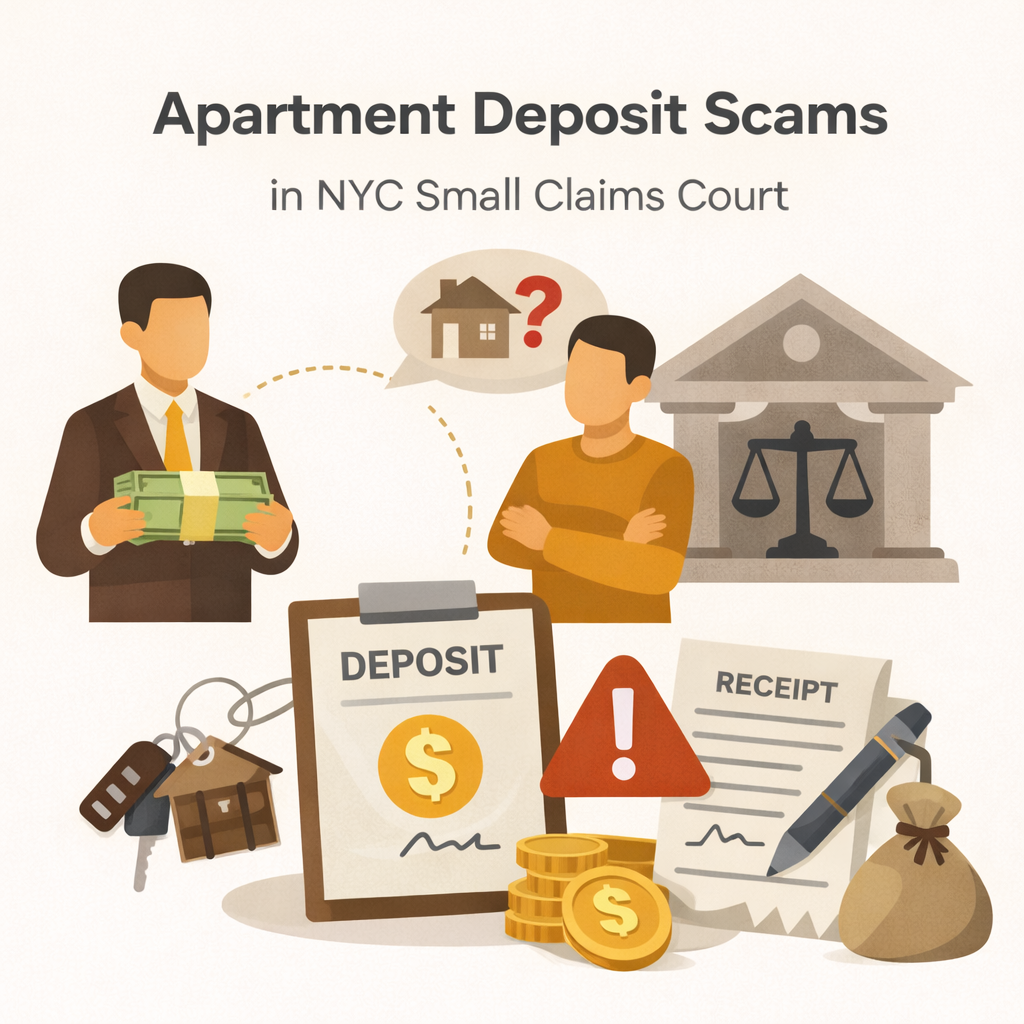
Apartment deposit scams are a common problem in New York City. These disputes often happen when someone pays a deposit for an apartment, rental application, or supposed lease, and then the apartment is unavailable, the person disappears, or the deposit is never returned. In NYC Small Claims Court, these cases may fit when you are seeking money only and the total amount claimed is $10,000 or less.
Disclaimer: This article is for informational purposes only. We are not attorneys and do not provide legal advice.
Quick Answer
Yes, an apartment deposit scam may sometimes be brought in NYC Small Claims Court if you are trying to recover money that was paid and never returned. The court’s Small Claims Part hears cases where parties seek monetary relief up to $10,000, not orders forcing someone to do something else.
What Is an Apartment Deposit Scam?
In plain terms, this usually means money was paid for an apartment-related purpose and the payer believes the payment was taken wrongfully or fraudulently. Common examples include:
- paying a deposit for an apartment that was never actually available,
- sending money after seeing a fake listing,
- paying someone who claimed to control the apartment but did not,
- or paying a deposit that was never returned after a rental arrangement fell apart.
These cases often overlap with broader money owed, fraud, or deposit dispute situations. Small Claims Court can handle the money side of the dispute if the defendant can be identified and the case fits the court’s rules.
When This May Fit in NYC Small Claims Court
A deposit-scam case may fit in Small Claims Court when:
- you paid money,
- you can identify the person or business you are claiming against,
- you are asking for a money judgment,
- and the amount is within the court’s limit.
The NYC Small Claims Part is designed for monetary disputes only, up to $10,000. If the amount is higher, the case must be started in another court part.
What Proof May Help
For apartment deposit scam claims, the most useful proof is usually anything that shows:
- who took the money,
- why the money was paid,
- how much was paid,
- and why you say it should be returned.
Helpful evidence may include:
- payment receipts,
- Zelle, Venmo, Cash App, wire, or bank records,
- text messages and emails,
- apartment listing screenshots,
- lease drafts or agreements,
- application forms,
- IDs, business names, or addresses used by the other side,
- and any messages promising a refund or confirming the payment.
New York small claims guides emphasize bringing organized records and documents to prove the claim.
What If It Was a Real Landlord and a Real Security Deposit?
Some apartment deposit disputes are scams, while others are more traditional security deposit disputes. The New York Attorney General says a landlord must return a tenant’s security deposit within 14 days after the tenant moves out, and if deductions are taken, the landlord must provide an itemized statement. The AG also says that if the landlord does not comply, the tenant may be entitled to up to twice the amount of the security deposit.
That type of issue may still be a money dispute that can be brought in Small Claims Court if it fits the amount and court-jurisdiction rules.
Can You Sue If the Person Disappeared?
Possibly, but it depends on whether you can identify and locate the correct defendant well enough to file and serve the case. A strong small claims case needs more than proof that money was lost; it also needs a defendant the case can actually be brought against. The official NYC small claims starting page explains that a case begins by filing a statement of claim in the proper county.
Can You Also File an Attorney General Complaint?
Yes. The New York Attorney General has a Rent Security Complaint Form and says it investigates tenant complaints about rental security deposits and advance fees. That is separate from Small Claims Court, but it may be useful in some situations involving real landlords or rental deposit issues.
What Small Claims Court Can and Cannot Do
Small Claims Court may award money if the judge decides money is owed. It generally is not the place to force someone to rent you the apartment, complete a lease, or provide non-money relief. The NYC courts are clear that the Small Claims Part hears cases seeking monetary relief only.
Quick Reference
- NYC Small Claims Court handles money claims up to $10,000.
- Apartment deposit scam claims may fit when you are trying to recover money paid and not returned.
- Strong proof may include payment records, listing screenshots, lease drafts, and messages.
- For real landlord security deposits, the Attorney General says deposits generally must be returned within 14 days after move-out, with an itemized statement for deductions.
- The Attorney General also provides a Rent Security Complaint Form for tenant deposit complaints.
Conclusion
Apartment deposit scams in NYC often become money recovery disputes, and that is why some of them may fit in NYC Small Claims Court. The most important factors are usually whether you can identify the defendant, show the payment clearly, and document why the money should be returned.
If you need help getting started, we offer preparation and filing services that allow you to create your claim online and have it properly processed for NYC filing.