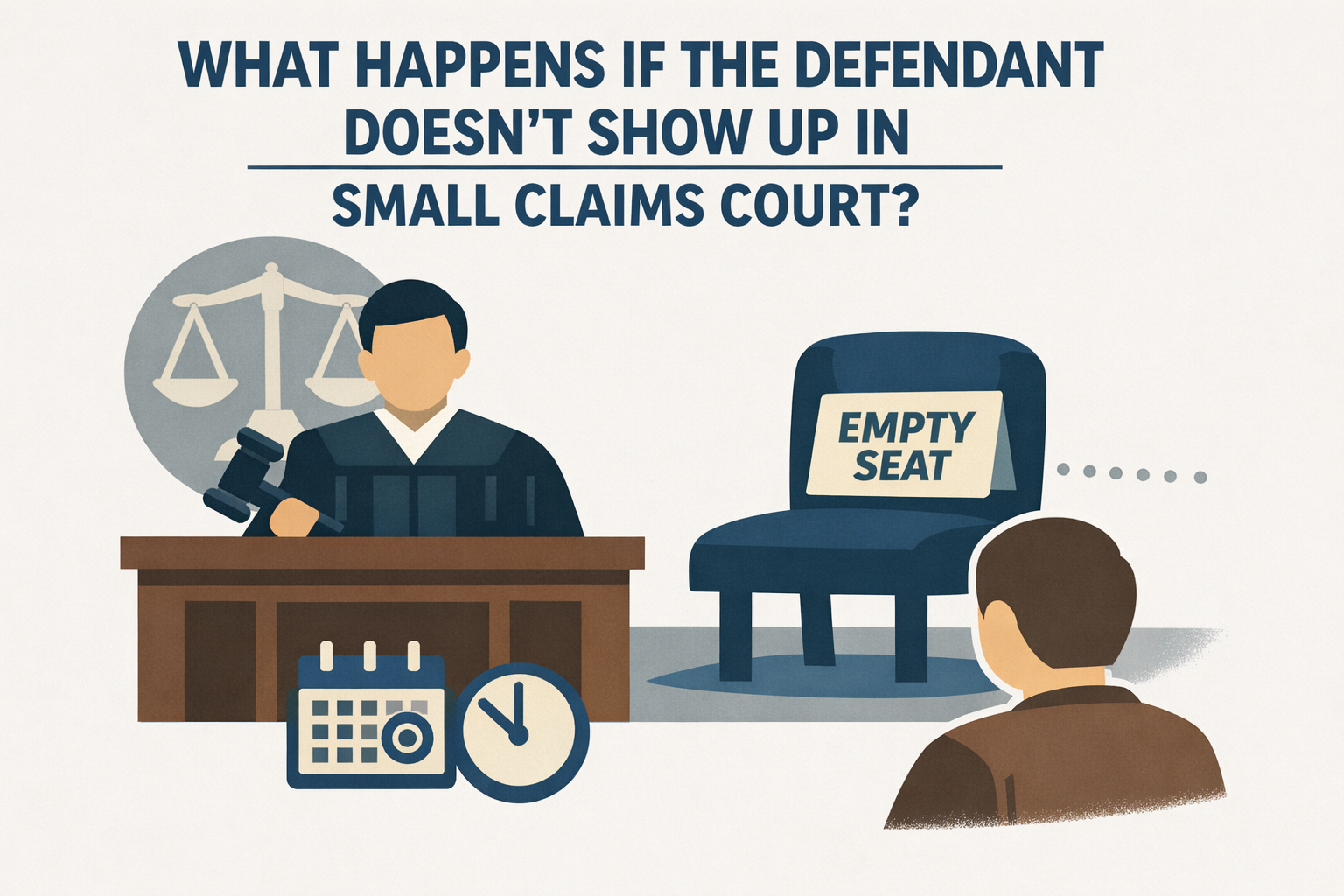
Learn what may happen if the defendant doesn’t appear in NYC Small Claims Court, including inquests, default judgments, and what the court may require from the claimant.
Introduction
If the defendant does not show up in NYC Small Claims Court, the court may still hear the case without them. In many situations, the court will hold an inquest, which means the judge or arbitrator hears the claimant’s side and reviews the evidence even though the defendant is absent. If the claimant proves the case, the court may enter a default judgment against the defendant.
Disclaimer: This article is for informational purposes only. We are not attorneys and do not provide legal advice.
Quick Answer
A defendant’s absence does not automatically mean an automatic win for the claimant. The claimant still usually has to appear, explain what happened, and provide enough proof for the judge or arbitrator. If the evidence is sufficient, the court may award a default judgment.
What Is an Inquest?
An inquest is a hearing that takes place when only the claimant is present because the defendant failed to answer or appear. In an inquest, the claimant must still prove the allegations and the amount of money being requested to the satisfaction of the court.
Does the Claimant Still Have to Bring Evidence?
Yes. Even if the defendant is absent, the claimant should still be prepared with documents, receipts, photographs, estimates, contracts, messages, or other proof. Court guidance makes clear that the claimant must still establish the case with evidence before a default judgment may be awarded.
What Is a Default Judgment?
A default judgment is a judgment entered because the defendant did not appear or did not respond. In Small Claims Court, if the claimant shows enough evidence during the inquest, the court may enter judgment for the amount proven. More generally, New York Court Help explains that a default judgment may allow the plaintiff to recover the amount requested, plus interest and court costs where applicable.
Can the Defendant Do Anything Later?
Yes. If a judgment is entered because the defendant defaulted, the defendant may try to ask the court to vacate the judgment. New York Court Help explains that common reasons for vacating a default judgment include excusable default and lack of personal jurisdiction, often tied to bad service. The NYC Small Claims court also has a page explaining that a defendant who defaulted may seek to have the judgment vacated.
What If the Defendant Never Got Notice?
That can matter. Official NYC Small Claims guidance says that if the post office cannot deliver the notice of claim, the clerk may issue a new hearing date and explain how to arrange personal delivery of the notice. Problems with service can later become important if a defendant asks the court to vacate a default judgment.
What Happens If the Claimant Doesn’t Show Up Instead?
If the claimant does not appear when the case is called, the court may dismiss the case. The small claims handbook explains that if the claimant is not in court when the clerk calls the case, the case may be dismissed, while if the defendant is absent, the court may hear the matter without them.
Quick Reference
- If the defendant does not appear, the court may hold an inquest.
- The claimant usually still must prove the case with evidence.
- If the proof is strong enough, the court may enter a default judgment.
- A defendant may later try to ask the court to vacate a default judgment.
Conclusion
When a defendant does not show up in NYC Small Claims Court, the case may still move forward. The court may hear the claimant’s side through an inquest, and if enough evidence is presented, a default judgment may be entered. That is why it is still important for the claimant to come prepared with organized proof, even if the other side does not appear.
If you need help getting started, we offer preparation and filing services to make the process easier and more organized.