Learn what evidence is commonly used in NYC Small Claims Court, including receipts, contracts, photos, witnesses, records, and subpoenas.
Introduction
In NYC Small Claims Court, evidence is the proof that helps explain what happened and how much money is being claimed. The official court guidance says you should bring all evidence necessary to prove your claim or defense, including documents and other proof that support the facts in dispute.
Disclaimer: This article is for informational purposes only. We are not attorneys and do not provide legal advice.
Quick Answer
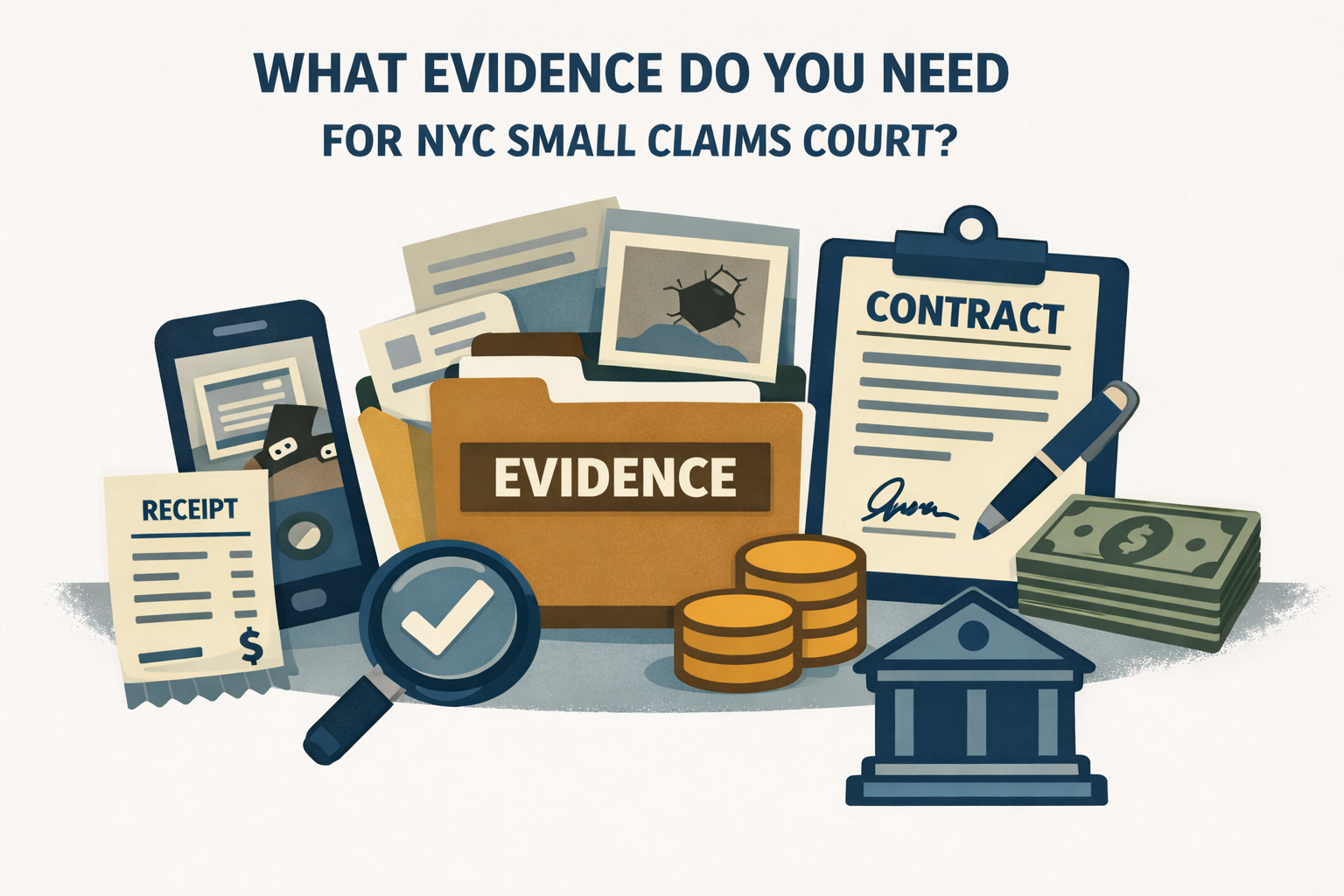
The most common evidence in NYC Small Claims Court includes:
- contracts or written agreements,
- receipts and invoices,
- photographs or videos,
- text messages, emails, or letters,
- repair estimates,
- payment records,
- and witnesses with firsthand knowledge.
The New York courts specifically point to documents, records, and witnesses as important forms of proof.
Common Types of Evidence to Bring
Written Agreements
If the dispute involves services, a sale, a rental, or money owed, written agreements can be very helpful. Court guidance says to bring written agreements, leases, receipts, and photographs when they help prove the facts in dispute.
Receipts, Bills, and Invoices
Receipts and invoices can help show:
- what was paid,
- when it was paid,
- and how much money is in dispute.
These are especially useful in consumer, contractor, mechanic, deposit, and debt-related cases.
Photos and Videos
Photos and videos can help show damage, poor workmanship, defective products, or the condition of property before and after an event. Court guidance specifically lists photographs as evidence that may help prove the disputed facts.
Messages and Communications
Emails, texts, letters, and chat messages can help show:
- what was promised,
- what each side said,
- whether payment was requested,
- and whether there was an attempt to resolve the issue.
The court FAQ also recognizes that records and documents may be central to proving a case.
Payment Records
Bank statements, credit card statements, Venmo, Zelle, or similar payment records can help show whether money was paid and in what amount. They are especially useful in unpaid debt, rent, refund, and scam-related disputes. These fall within the kinds of records the court describes as useful proof.
Repair Estimates or Replacement Costs
If your case involves damage, it often helps to bring repair estimates, invoices, or replacement costs. These documents can help explain the dollar amount you are asking the court to award.
Do You Need Original Documents?
Court guidance says originals—not photocopies—may be required in some situations, so it is safer to bring the original document whenever possible. If you also want the judge to see extra copies, bring both the original and copies.
What If Public Records Are Important?
If you plan to use public records, the court guidance says they should be certified by the agency that created them. Certification helps show the documents are true copies of the agency’s records.
What If a Witness Does Not Want to Come?
The official small claims handbook says you can ask the Small Claims Court Clerk for a subpoena. A subpoena is a court order that can require a witness to:
- come to court and testify, or
- send documents or records to the court.
The handbook also says:
- the clerk will help fill out the subpoena,
- the subpoena must be served by someone else who is 18 or older,
- and the witness is entitled to a $15 witness fee when served.
What If You Need Expert Evidence?
Some cases may involve technical issues. The handbook explains that in certain kinds of cases, an expert witness may be needed, and in most cases an expert must be paid to testify. The handbook also states that you cannot use a subpoena to force an expert witness to testify.
How Should You Organize Your Evidence?
A simple way to prepare is to group your proof by topic:
- what happened,
- what was promised,
- what was paid,
- what went wrong,
- and how much money is being requested.
On court day, NYC small claims guidance says to arrive early and be ready when your case is called, so having your documents organized can make it much easier to present your side clearly.
Only bring physical hard copies of all evidence. If you have media (videos/audio/pictures), it must be placed on a USB which may need to be turned into the court at the time of your hearing, and if you are requested to play the media, you cannot use your phone, instead, you may use a tablet or a laptop.
Quick Reference
- Bring all evidence necessary to prove your claim or defense.
- Common proof includes contracts, receipts, photos, and records.
- Bring originals when possible.
- Public records should be certified.
- If a witness or records holder will not cooperate, you may ask the clerk for a subpoena.
Conclusion
The best evidence for NYC Small Claims Court is the evidence that clearly shows what happened, what was agreed to, what money is involved, and why you are asking the court for that amount. Documents, receipts, photos, messages, and witnesses can all help build a stronger presentation.
If you need help getting started, we offer preparation and filing services to make the process easier and more organized.